Huawei Mate 40 Pro 4G vs Xiaomi Redmi Note 15 Pro Plus
Quick Comparison
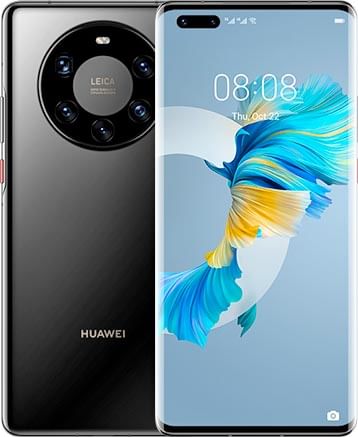
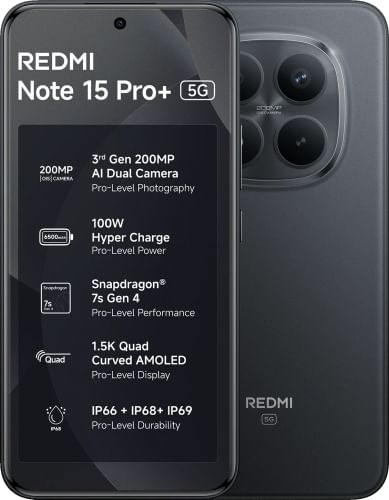
Both Huawei Mate 40 Pro 4G and Xiaomi Redmi Note 15 Pro Plus comes with same RAM. In terms of display resolution, Huawei Mate 40 Pro 4G has better resolution of 2772 x 1344 than Xiaomi Redmi Note 15 Pro Plus which has resolution of 2772 x 1280. Xiaomi Redmi Note 15 Pro Plus has more internal memory than Huawei Mate 40 Pro 4G
| Name | Huawei Mate 40 Pro 4G | Xiaomi Redmi Note 15 Pro Plus |
| RAM | 8 GB | 8 GB |
|---|---|---|
| Display | 6.76 in | 6.83 in |
| Internal Memory | 128 GB | 256 GB |
| Battery | 4400 mAh | 6500 mAh |
| Camera | 50 MP + 20 MP + 12 MP Triple | 200 MP + 8 MP Dual |
| Price | Rs. 69990 | Rs. 37999 |
Related Products



Detailed Comparison
Price And Launch
The launch Date of the first phone is June 28, 2021. The cost of Huawei Mate 40 Pro 4G is Rs. 69990. The launch Date of the second phone is December 18, 2025. The cost of Xiaomi Redmi Note 15 Pro Plus is Rs. 37999.
Display comparison
Xiaomi Redmi Note 15 Pro Plus has larger screen size of 6.83 inches in comparison to Huawei Mate 40 Pro 4G's 6.76 inch screen. Huawei Mate 40 Pro 4G has OLED Screen type where as Xiaomi Redmi Note 15 Pro Plus has AMOLED Screen type. Huawei's phone has display density of 456 PPI & Xiaomi's phone has only 447 PPI display density. In terms of screen to body ratio, Huawei's phone has better screen to body ratio of ~ 94.1% than Xiaomi's phone ~ 89.6%. Huawei Mate 40 Pro 4G has 18.5:9 aspect ratio where as Xiaomi Redmi Note 15 Pro Plus has 20.1:9 aspect ratio.
Memory comparison
Both mobiles come with 8 GB RAM Xiaomi Redmi Note 15 Pro Plus has more Internal Memory (256 GB) than Huawei Mate 40 Pro 4G (128 GB).
Camera comparison
Xiaomi Redmi Note 15 Pro Plus's 200 MP + 8 MP Dual Rear Camera outclasses Huawei Mate 40 Pro 4G's 50 MP + 20 MP + 12 MP Triple Rear Camera in terms of resolution. Xiaomi Redmi Note 15 Pro Plus will be better choice if you're looking to click lot of selfies as it has better 32 MP Front Camera in comparison to Huawei Mate 40 Pro 4G's 13 MP Dual Front Camera.
Related Comparisons


Full Comparison
| Name | Huawei Mate 40 Pro 4G | Xiaomi Redmi Note 15 Pro Plus |
| General | ||
| Country of Origin | India | |
| Model | Mate 40 Pro 4G | 2510ERA8BG |
| Sim Type | Dual Sim, GSM+GSM (Hybrid Slot) | Dual Sim, GSM+GSM |
| Dual Sim | Yes | Yes |
| Sim Size | Nano SIM | nano SIM + nano SIM or nano SIM + eSIM |
| Device Type | Smartphone | Smartphone |
| OS Updates | 4 years | |
| Security Updates | 6 years | |
| Release Date | June 28, 2021 | December 18, 2025 |
| In The Box | REDMI Note 15 Pro+ 5G/ Adapter/ USB Type-C Cable/ SIM Eject Tool/ Protective Case/ Quick Start Guide/ Warranty Card | |
| Design | ||
| Dimensions | 75.5 x 162.9 x 9.1 mm | 78.3 x 163.3 x 8.2 mm |
| Weight | 212 g | 207 g |
| Colors | Mirage Blue, Coffee Mocha, Carbon Black | |
| Display | ||
| Type | Color OLED Screen (16M Colors) | Color AMOLED Screen (1B Colors) |
| Touch | Yes | Yes |
| Size | 6.76 inches, 1344 x 2772 pixels, 90 Hz | 6.83 inches, 1280 x 2772 pixels, 120 Hz |
| Aspect Ratio | 18.5:9 | 20.1:9 |
| PPI | ~ 456 PPI | ~ 447 PPI |
| Screen to Body Ratio | ~ 94.1% | ~ 89.6% |
| Glass Type | Corning Gorilla Glass Victus 2 | |
| Brightness | 3200 nits Peak, HBM 1800 nits | |
| Features | HDR10 | 3840Hz PWM, HDR10+, Dolby Vision, Colour depth: 12bit Contrast ratio: 8,000,000:1 DCI- P3 wide color gamut |
| Notch | Yes, Punch Hole | Yes, Punch Hole |
| Memory | ||
| RAM | 8 GB | 8 GB |
| Storage | 128 GB | 256 GB |
| Storage Type | UFS 3.1 | UFS 2.2 |
| Card Slot | Yes, (Hybrid Slot), upto 256 GB | No |
| Connectivity | ||
| GPRS | Yes | Yes |
| EDGE | Yes | Yes |
| 3G | Yes | Yes |
| 4G | Yes | Yes |
| 5G | Yes | |
| 5G Bands | SA: n1/3/5/8/28/38/40/41/77/78, NSA: n1/3/5/8/28/40/41/77/78 | |
| VoLTE | Yes, Dual Stand-By | Yes, Dual Stand-By |
| Wifi | Yes, with wifi-hotspot | Yes, with wifi-hotspot |
| Wifi Version | Wi-Fi: Wi-Fi 6/6E/Wi-Fi 5/Wi-Fi 4/Wi-Fi Direct Supports 2.4GHz Wi-Fi | 5GHz Wi-Fi Supports 2x2 MIMO | |
| Bluetooth | Yes, v5.2, A2DP, LE | Yes, v5.4, A2DP, LE |
| USB | Yes, USB-C v3.1 | Yes, USB-C v2.0 |
| USB Features | USB Tethering, USB on-the-go, USB Charging | USB on-the-go, USB Charging |
| IR Blaster | Yes | Yes |
| Performance | ||
| AnTuTu Score | 1,053,798 (Total) (v11) 405,501 (CPU) 188,358 (GPU) 203,399 (Memory) 256,540 (UX) | |
| AnTuTu Storage Score | 85,008 Sequential Read: 1093 MB/s; Sequential Write: 1054 MB/s | |
| Geekbench Score | 3,250 (Multi Core) (v6) 1,250 (Single Core) 3,538 (OpenCL) 4,690 (Vulkan) | |
| 3DMark Score | 1,104 (Wild Life Extreme) (6.61 FPS) | |
| Extra | ||
| GPS | Yes, with A-GPS. Up to quad-band: GLONASS (4), BDS (4), GALILEO (3), QZSS (2), NavIC | GPS | AGPS | Glonass | Beidou | Galileo make wireless Down Wireless network | Data network | Sensor Assisted Positioning |
| Fingerprint Sensor | Yes, In Display | Yes, In Display |
| Face Unlock | Yes | Yes |
| Sensors | Accelerometer, Gyro, Proximity, Barometer, Compass, Color Spectrum | Proximity sensor | Ambient light sensor | Accelerometer | Electronic compass | IR blaster | Gyroscope |
| 3.5mm Headphone Jack | No | No |
| NFC | Yes | Yes |
| AI Features | Al Writing, Al Speech Recognition, Al Interpreter,Al Search, Al Dynamic Wallpapers, Al Creativity Assistant,and more. Circle to Search with Google, Google Gemini information. | |
| Water Resistance | Yes | Yes, 1.5 m upto 30 min |
| IP Rating | IP68 | IP66 + IP68 + IP69 + IP69K |
| Dust Resistant | Yes | Yes |
| Extra Features | Xiaomi T1S Tuner, Xiaomi Offline Communication | |
| Camera | ||
| Rear Camera | 50 MP ƒ/1.9 (Wide Angle) 12 MP ƒ/3.4 (Telephoto) 20 MP ƒ/1.8 (Ultra Wide) | 200 MP ƒ/1.7 (Wide Angle) 23mm (wide), 1/1.4", 0.56µm, multi-directional PDAF, OIS 8 MP ƒ/2.2 (Ultra Wide) 15mm, 120˚ (ultrawide), 1/4.0", 1.12µm |
| OIS | Yes | Yes |
| Auto Focus | Yes | Yes |
| Features | Leica Optics, Panorama, HDR | |
| Video Recording | 4K @ 30 fps UHD, 1080p @ 30 fps FHD, 720p @ 3840/960 fps HD | 4K @ 30 fps UHD, 1080p @ 60 fps FHD |
| Flash | Yes, LED | Yes, LED |
| Front Camera | 13 MP ƒ/2.4 (Ultra Wide) TOF 3D Punch Hole, Screen Flash | 32 MP ƒ/2.2 (Wide Angle) Punch Hole |
| Front Video Recording | 4K @ 30 fps UHD, 1080p @ 30 fps FHD | 1080p @ 60 fps FHD |
| Technical | ||
| OS | Harmony v2.0 | Android v15 |
| Custom UI | Xiaomi HyperOS 2 | |
| Chipset | HiSilicon Kirin 9000 | Qualcomm Snapdragon 7s Gen4 |
| CPU | 3.13 GHz, Octa Core Processor | 2.7 GHz, Octa Core Processor |
| Core Details | 1x3.13 GHz Cortex-A77 & 3x2.54 GHz Cortex-A77 & 4x2.05 GHz Cortex-A55 | 1x2.7 GHz Cortex-A720 & 3x2.4 GHz Cortex-A720 & 4x1.8 GHz Cortex-A520 |
| GPU | Mali-G78 MP24 | Adreno 810 |
| Java | No | No |
| Browser | Yes | Yes, supports HTML5 |
| Multimedia | ||
| Yes | Yes | |
| Music | Yes | MP3, AMR, FLAC, APE |
| Video | Yes | MP4, M4V, MKV, XVID |
| FM Radio | No | No |
| Speaker Type | Dual Stereo | |
| Audio Features | 400% Volume Boost, Dolby Atmos | Hi-Res | |
| Document Reader | Yes | Yes |
| Battery | ||
| Type | Non-Removable Battery | Non-Removable Battery |
| Size | 4400 mAh, Li-Po Battery | 6500 mAh, Silicon-Carbon Battery Battery |
| Fast Charging | Yes, 66W Fast Charging | Yes, 100W Fast Charging |
| Wireless Charging | Yes, 50W | |
| Reverse Charging | Yes, 5W | Yes, 22.5W |